From Sharecropper's Son to Leader of a Nation
Aminjan Irmatovich Niyazov was born on 7 November 1903 in the kishlak of Ak-Tepe near Margilan, in the Fergana Valley of what was then the Russian Empire. His father, Irmat-aka, was an izdolshchik — a sharecropper who labored on the lands of wealthy bais, owning nothing of his own. From these humblest of origins, Aminjan would rise through decades of tireless service to become the de facto leader of Uzbekistan, one of the largest Soviet republics.
His life spanned the entire arc of Soviet history: from the collapse of the Tsarist empire and the chaos of civil war, through the brutal industrialization drives, the Great Patriotic War, and the complex power struggles of the post-Stalin era. At every stage, he served — not for personal enrichment, but out of an unshakeable conviction that the children of sharecroppers deserved the same future as anyone.
He managed the finances of a wartime republic, built the irrigation infrastructure that fed millions, mechanized cotton harvests, constructed schools and hospitals, hosted world leaders — and was ultimately dismissed in a political maneuver by the very man who had once been his classmate. He bore it without bitterness and continued to serve in whatever capacity he could, until his health — broken by seventeen years without a single vacation — finally gave way.
Timeline
A chronological summary of seven decades of public service — from the famine of the Fergana Valley to the highest councils of Soviet Central Asia.
Early Years
Young Aminjan began his education at an old-style maktab before transitioning to a modern school, where he showed early promise in physics and mathematics. But history did not allow him a peaceful childhood. The Russian Civil War brought famine to Fergana — he survived on grass and oil cake, watching his neighbors starve.
At just sixteen, in 1919, he joined the Fergana district food committee, helping distribute expropriated grain to the starving population. He then served as secretary of the Fergana city Komsomol committee, throwing himself into the revolutionary project with the idealism of youth and the discipline that would define his career.
Through the 1920s, he worked in the Turkestan Cheka and GPU — the security organs of the young Soviet state — before transitioning to financial administration. In 1926, he was appointed head of the Finance Department of the Fergana Oblast Soviet executive committee. He personally implemented land-water reform: confiscating land and irrigation channels from the wealthy bais and redistributing them to landless dehkans.
In 1925, he joined the Communist Party. By 1929, he headed the state seed fund, demonstrating the administrative competence that would carry him steadily upward.
Education & Industry
In 1930, Niyazov was sent to study at the All-Union Industrial Academy named after J.V. Stalin in Moscow — the Soviet Union's premier institution for training industrial leaders. There, crowded into a one-room apartment with his young family, he excelled in machine parts, strength of materials, and theoretical mechanics, earning only excellent marks.
Among his classmates was Nikita Sergeyevich Khrushchev — a fact that would echo through history decades later, when the same Khrushchev, now leader of the Soviet Union, would preside over Niyazov's political downfall.
After graduating in 1934, he volunteered to go as an ordinary worker to the construction of the Chirchik electrochemical combine — one of Central Asia's largest industrial projects. His competence quickly became impossible to ignore: he rose from foreman to site manager, then chief engineer, and finally head of the construction control committee under the Council of People's Commissars.
When some specialists tried to prove that Fergana's climate was unsuitable for textile and silk-reeling factories, Niyazov proved them wrong. He became one of the leaders of the Fergana textile construction program, sending approximately 900 young workers to textile centers in Russia for training. They returned to staff the new factories that transformed the region's economy.
The Great Patriotic War & Finance
In 1940, Niyazov was appointed People's Commissar (Narkom) of Finance of the Uzbek SSR. When Germany invaded the Soviet Union in June 1941, this administrative role became a matter of national survival.
Uzbekistan became one of the primary evacuation destinations for Soviet industry, population, and military production. Entire factories were dismantled, loaded onto trains, and shipped thousands of kilometers east to be reassembled and operational as quickly as possible. The scale was staggering: 280 new industrial enterprises were built and made operational during the war years. New industries appeared in Uzbekistan for the first time — aviation, machine tools, heavy industry, non-ferrous and ferrous metallurgy.
Beyond the factories and furnaces, wartime Uzbekistan became something rarer in the twentieth century: a sanctuary. Between the summer of 1941 and the spring of 1942, more than one and a half million Soviet citizens were evacuated to the Uzbek SSR, and among them were several hundred thousand Jewish refugees fleeing the advancing front of the Holocaust. They came from Ukraine, Belarus, Crimea, the Baltic republics, and from the cities of pre-war Poland — boarding eastbound trains with what little they could carry, drawn by a phrase that had passed from mouth to mouth across a continent at war: Tashkent, the City of Bread. By February 1942, more than 156,000 Jewish refugees had been registered in Tashkent before being resettled across the republic, and Samarkand became a second great reception centre for those evacuated from the lost territories of the west.
The reception of so many destitute strangers in a republic itself stripped of grain, fuel, and able-bodied men was, beyond every act of personal kindness, an administrative undertaking of extraordinary scale. Housing had to be requisitioned, ration cards issued, hospitals enlarged, evacuated schools and theatres funded, orphanages opened for children who arrived alone. Every line of that effort passed, in the end, through the budget of the Uzbek SSR — through the People's Commissariat of Finance that Aminjan Niyazov had directed since 1940. The historical record does not place him personally at the railhead in Tashkent or at the door of a Samarkand shelter, and it would not honour him to claim otherwise. But the food shared at those doors, the roofs raised over those families, the wages of the doctors who treated them, were made possible by the public finances he was charged to keep solvent through the longest and hardest years his republic had ever known.
The Chkalov Aviation Factory — evacuated from European Russia — was made operational within just 42 days of arriving in Uzbekistan. Behind every one of these feats of logistics stood the financial apparatus that Niyazov commanded: allocating funds, managing budgets, ensuring that the money flowed where the war effort needed it most.
Niyazov's role as financial commissar placed him at the highest strategic echelon of the republic's war effort — ensuring that every evacuated factory, every new production line, and every wartime initiative had the funding it needed to succeed.
After the war, in 1946, Niyazov was elevated to Deputy Chairman of the Council of People's Commissars (later the Council of Ministers) of the Uzbek SSR — recognition of his indispensable wartime service.
Rise to Power
In 1947, Niyazov became Chairman of the Presidium of the Supreme Soviet of the Uzbek SSR — the formal head of state of Uzbekistan. In this role, he initiated the construction of the massive irrigation infrastructure that would transform the agricultural landscape of Central Asia: the Kattakurgan and Chimkurgan reservoirs, land development in Central Fergana, the opening of the Hungry Steppe, and improved irrigation systems in the Bukhara, Samarkand, and Khorezm oblasts.
In April 1950, he reached the pinnacle: appointment as First Secretary of the Central Committee of the Communist Party of Uzbekistan, succeeding Usman Yusupov. He was now the de facto leader of a republic of millions — and a member of the Central Committee of the CPSU at the all-Union level.
Achievements as First Secretary
Under his leadership, Uzbekistan reached milestones that had never been achieved before:
Mechanization was a personal priority. Between 1950 and 1955, 22,428 SHM-48 cotton-harvesting machines — manufactured at the Tashselmash factory in Tashkent — were deployed across Uzbekistan, transforming cotton harvesting from backbreaking manual labor into mechanized production.
He built 42 new schools and ensured they were supplied with textbooks and materials. He organized state-funded meals for 1,000 boarding school children. He established the Medical Institute in Andijan, the Institute of Regional Medicine, and the Research Institute of Oncology and Radiology. He built power stations — the Namangan HPP, the Bukhara diesel station, the Karshi thermal plant, the Angren GRES — and an auto-repair factory in Andijan.
He created "Suburban Zones" around cities to ensure the urban population had reliable access to fresh vegetables and dairy. He purchased 3,000 pedigree heifers from abroad to improve livestock quality. He secured higher procurement prices from the USSR government for Uzbekistan's key exports: cotton, karakul pelts, and silk.
Foreign Policy
Uzbekistan, with its Muslim majority and its borders touching Afghanistan, was the Soviet Union's natural showcase to the newly independent states of Asia. Working with Foreign Minister Vyacheslav Molotov, Niyazov helped open channels to the leaders of the twenty-nine non-aligned nations gathered at the 1955 Bandung Conference, offering Tashkent as a meeting ground between Moscow and the post-colonial world.
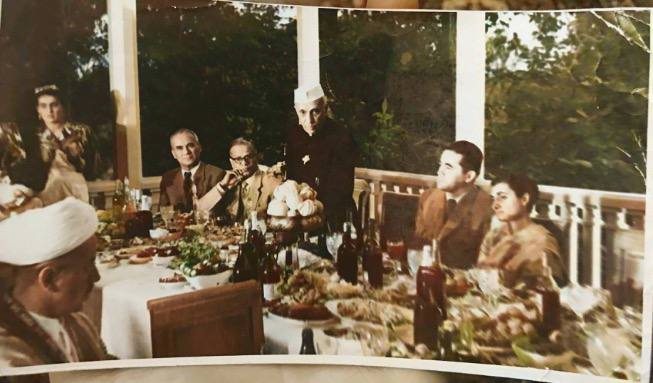
In 1955 he received Prime Minister Jawaharlal Nehru of India and his daughter Indira Gandhi — among the first heads of a major non-aligned state to visit Soviet Central Asia — and shortly afterwards welcomed U Nu, the Prime Minister of Burma. The receptions, the cultural exchanges, the visits to the new factories and the Navoi Opera, were stagecraft and diplomacy at once: a republic that had been a Tsarist colony fifty years earlier was now hosting the leaders of an awakening continent.
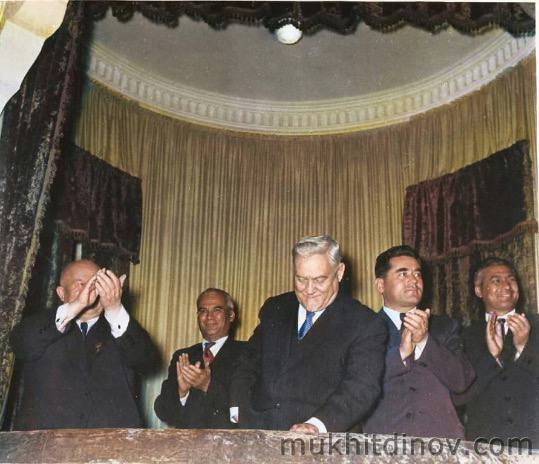
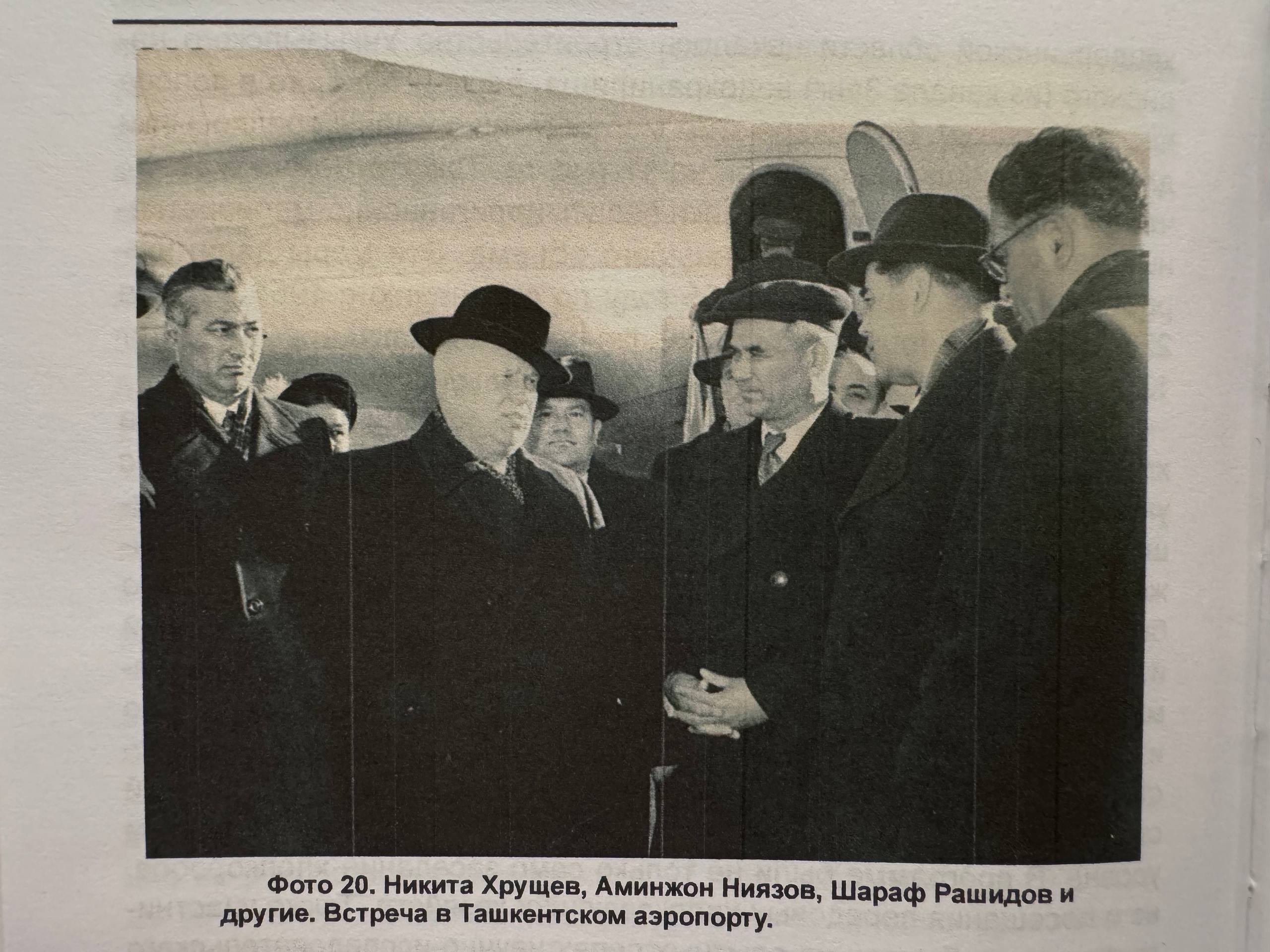
In the autumn of 1955, Nikita Khrushchev and Premier Nikolai Bulganin completed the diplomatic arc by touring India, Burma, and Afghanistan, returning to Moscow via Tashkent. Niyazov met them at the airport, escorted them through the city he had helped to build, and listened as Khrushchev — speaking at a hastily convened conference of Uzbek cotton workers — laid the rhetorical groundwork for the political move he was about to make. Within weeks, the same airport would mark the end of Niyazov's tenure as First Secretary.
What He Built
Across five decades — as engineer, finance commissar, head of state, and First Secretary — Niyazov authorised, financed, or personally directed the construction of the infrastructure on which post-war Uzbekistan was built. A partial inventory, organised by domain:
Power & Industry
- Chirchik Electrochemical Combine — chief engineer of construction (1934–40)
- Namangan Hydroelectric Power Station #3
- Bukhara diesel power station
- Karshi Thermal Power Plant
- Angren State Regional Electric Station (GRES)
- Andijan auto-repair factory
- Fergana textile and silk-reeling complex (1930s expansion)
Water & Land
- Kattakurgan Reservoir
- Chimkurgan Reservoir
- Kairakum Reservoir (joint project with the Tajik SSR)
- Central Fergana land development
- Hungry Steppe (Mirzachoʻl) opening — pilot stage, 1947–1950
- Irrigation systems in Bukhara, Samarkand, and Khorezm oblasts
Education
- 42 new schools with full textbooks and supplies
- State-funded meals for 1,000 boarding-school children
- Andijan Medical Institute (1955)
- Training programme sending ~900 young workers to Russian textile centres
Health & Science
- Institute of Regional Medicine, Academy of Sciences (later the Institute of Endocrinology)
- Research Institute of Oncology and Radiology
Transport & Utilities
- Tashkent–Kokand highway (post-retirement project)
- Residential natural gas supply — first in the republic
Agriculture & Trade
- "Suburban Zone" — fresh vegetables and dairy supply for cities
- Import of 3,000 pedigree heifers to improve livestock
- 22,428 SHM-48 cotton-harvesting machines deployed across the republic
- Negotiated higher procurement prices for cotton, karakul, and silk
The Cotton Crisis & Fall from Power
In late autumn 1955, Nikita Khrushchev and Premier Nikolai Bulganin returned to Moscow from a high-profile diplomatic tour of India, Burma, and Afghanistan, stopping in Tashkent on the way. Khrushchev convened a conference of Uzbek cotton specialists, walked them through his expectations, and signalled — sharply and publicly — that change was coming. On 22 December 1955, at an Extraordinary Plenum of the Central Committee of the Communist Party of Uzbekistan, Aminjan Niyazov was relieved of the First Secretaryship and replaced by Nuritdin Mukhitdinov. The official reason, never publicly elaborated, was that he had failed to sufficiently increase cotton production.
The political dimension was unmistakable. Khrushchev was systematically replacing the generation of First Secretaries who had risen under Stalin with younger figures he could trust personally — a campaign that would soon touch Turkmenistan (1958), Tajikistan, Moldavia, and Kyrgyzstan (1961). Niyazov, a former classmate of Khrushchev at the All-Union Industrial Academy, had declined to join factions or to support Khrushchev's intra-Presidium manoeuvring. For a leader now consolidating supreme power, that reticence was sufficient cause. Mukhitdinov, by contrast, would soon prove his loyalty by defending Khrushchev against the 1957 "Anti-Party Group" — and was rewarded with a seat on the CPSU Presidium, the first Central Asian to reach that height.
A third dimension is one the family has always carried, and that the available archival record at least does not contradict. Niyazov's signature irrigation legacy lay in reservoirs — Kattakurgan, Chimkurgan, Kairakum — which store seasonal water and serve mixed agriculture. What Moscow now wanted from Central Asia was something fundamentally different: massive interbasin diversions that would carry the Amu Darya and Syr Darya across deserts to bring vast new tracts under cotton monoculture. The Karakum Canal, eventually drawing some thirteen cubic kilometres a year from the Amu Darya, had already begun in 1954. The family's account — passed down by his children and grandchildren — is that Niyazov resisted Khrushchev's demand to pivot the republic onto that more radical path, understanding what it would do to the Aral Sea and to the soils of Central Asia. He was, in the family's reading, removed not for failing to grow more cotton, but for refusing to grow it in the way Moscow now insisted.
The structural evidence is, at the very least, suggestive. Within eight months of his dismissal, on 6 August 1956, the USSR Council of Ministers and the Central Committee jointly issued Decree N° 1059, "On the irrigation of virgin lands of the Hungry Steppe in the Uzbek SSR and the Kazakh SSR for increasing cotton production," opening some 800,000 hectares of new cotton land. The diversion era — the era that would eventually destroy the Aral Sea — began in earnest under Niyazov's successors. The cotton politics that surrounded his removal would foreshadow the much larger "Uzbek Cotton Affair" of the 1970s–80s, which would in turn consume his eventual successor Sharaf Rashidov.
In his diminished role, Niyazov characteristically found a way to serve. As Minister of Municipal Economy of the Uzbek SSR, he pioneered the supply of natural gas to Uzbekistan's residential population for the first time in the republic's history — a quiet but transformative achievement that improved the daily lives of millions. In retirement, he helped plan and build the Tashkent–Kokand highway, connecting the Fergana Valley to the rest of the republic.
An Epilogue Written in Salt
Niyazov did not live to see what those decisions produced. By 1960, when Soviet planners were celebrating record cotton harvests, the Aral Sea — fed by the Amu Darya and the Syr Darya — was already losing its equilibrium between inflow and evaporation. By 1987, the sea had split in two. By 2014, the eastern lobe had effectively vanished, leaving the toxic salt pan of the Aralkum where fishing villages had stood within living memory. National Geographic, in its 2015 retrospective "Sins of the Aral Sea," traced the intellectual ancestry of the catastrophe to the Russian climatologist Aleksandr Voeikov (1842–1916), whose writings on Central Asian water — cited approvingly by Soviet water bureaus from the 1920s through the 1960s — were read by planners as a licence to drain.
— paraphrased in Mark Synnott, "Sins of the Aral Sea," National Geographic, June 2015
Yusup Kamalov, the Karakalpak scientist who has spent his life chronicling the disaster, put it plainly to National Geographic: "This is what the end of the world looks like… Can you imagine that forty years ago the water was thirty metres deep right here. Now instead of water vapour in the atmosphere, we have toxic dust… That water belongs to the Aral."
In 2026, Uzbekistan brought its third national pavilion to the Venice Art Biennale under the title The Aural Sea. Its curators framed the project as "an attempt to rethink the experience of the Aral Sea region in Karakalpakstan, using imagination as a tool… visitors are invited to reflect on Aral's future, based on knowledge extracted from the bitter lessons of the past." For a republic still living with the ecological consequences of decisions made in Moscow in the late 1950s, that reckoning is not an abstraction. Whatever the precise weight one assigns to each cause of Aminjan Niyazov's removal in December 1955 — political loyalty, generational turnover, a refusal to pivot from reservoirs to mass diversion — the road that ran from his plenum to the dry seabed of the Aral was paved by the men, and the directives, that followed him.
In the Western Press
The American press greeted Niyazov's removal with a shrug and a raised eyebrow rather than a headline. The New York Times carried only a brief dispatch — "no reason … given" for the dismissal — but the Washington Evening Star, in a "Current Comment" reprinted by The Troy Record on 5 January 1956, took a moment to translate the silence. "It is safe to say that very few Americans sat up and took notice when a gentleman named Amin I. Niyazov was fired as First Secretary of the Uzbek Communist Party," the editorial began. "Yet this little-noticed event may not have been devoid of significance." The piece traced his fall to Khrushchev's recent, "outspokenly critical" speech to Uzbek farm workers about cotton output, and then placed Tashkent's politics inside a larger picture: Moscow needed cotton; Egypt had cotton and wanted Eastern-bloc arms; Niyazov's quiet exit was, in the Star's reading, a small consequence of a much larger Soviet bargain. It is one of the few contemporary American notices of his career to survive — a four-paragraph obituary for his First Secretaryship, written six weeks before he could even have answered it.
Legacy & Historical Significance
Aminjan Niyazov's biography is a mirror of the Soviet century. He was born into the feudal poverty of Central Asia and died in a Tashkent that he had personally helped transform into an industrial and cultural center. He survived the purges that consumed many of his contemporaries — including Akmal Ikramov, the very man who had once offered him the chance to study in Germany.
His irrigation infrastructure — the Kattakurgan and Chimkurgan reservoirs, the Hungry Steppe development, the canal systems across Bukhara, Samarkand, and Khorezm — physically reshaped the landscape of Central Asia. The factories he helped build during the war laid the industrial foundation of modern Uzbekistan. The mechanization of cotton harvesting freed tens of thousands from manual labor.
He was not a revolutionary romantic or a political operator. He was, in the most literal sense, a builder — of factories, reservoirs, schools, hospitals, power stations, and highways. His last honor, awarded just weeks before his death in November 1973, was the title "Honored Builder of the Uzbek SSR." It was, perhaps, the most fitting recognition he ever received.
He died on 26 December 1973, in Tashkent, at the age of seventy.
Awards & Honors
- Two Orders of Lenin
- Three Orders of the Red Banner of Labour
- Two Orders of the Red Star
- Honored Builder of the Uzbek SSR (1973)
- Honorary Diploma of the Government of Uzbekistan (Land Reform)
Contemporaries
A statesman is shaped by the men and women he works beside, and against. These were the figures whose decisions intersected most consequentially with Niyazov's career — predecessors and successors, classmates and rivals, comrades and judges.
First Secretary of the Communist Party of Uzbekistan when young Niyazov was rising through the financial bureaucracy. It was Ikramov who offered to send him to Germany among seventy promising cadres in 1930; Niyazov declined, citing his elderly mother. Ikramov himself was arrested in 1937 and executed in the Great Purge of 1938. Niyazov outlived his patron by thirty-five years.
First Secretary throughout the war years and the immediate post-war reconstruction, with Niyazov serving under him as Finance Commissar and then as Chairman of the Supreme Soviet. Transferred to Moscow in 1950 to head the USSR Ministry of Cotton, opening the path for Niyazov's promotion.
Fellow student at the All-Union Industrial Academy in Moscow in the early 1930s. The two men's careers ran in parallel for two decades. In December 1955, Khrushchev — now First Secretary of the entire Soviet Union — flew to Tashkent and presided over the plenum that removed Niyazov. He was, by the family's account, the architect of his political end.
USSR Foreign Minister with whom Niyazov coordinated the 1955 receptions of Nehru, Indira Gandhi, and U Nu of Burma. Tashkent under Niyazov became a Soviet showcase to the post-colonial world Molotov was courting.
Niyazov's immediate successor as First Secretary, installed at the 22 December 1955 plenum. Mukhitdinov rapidly defended Khrushchev against the 1957 "Anti-Party Group" and was rewarded with a seat on the CPSU Presidium — the first Central Asian to reach that height.
Took over from Niyazov as Chairman of the Supreme Soviet in 1950, and from Mukhitdinov as First Secretary in 1959 — serving an extraordinary twenty-four years. His tenure would be consumed in its final years by the "Uzbek Cotton Affair," the very politics whose first ripple had carried Niyazov out of power.
Photo Gallery
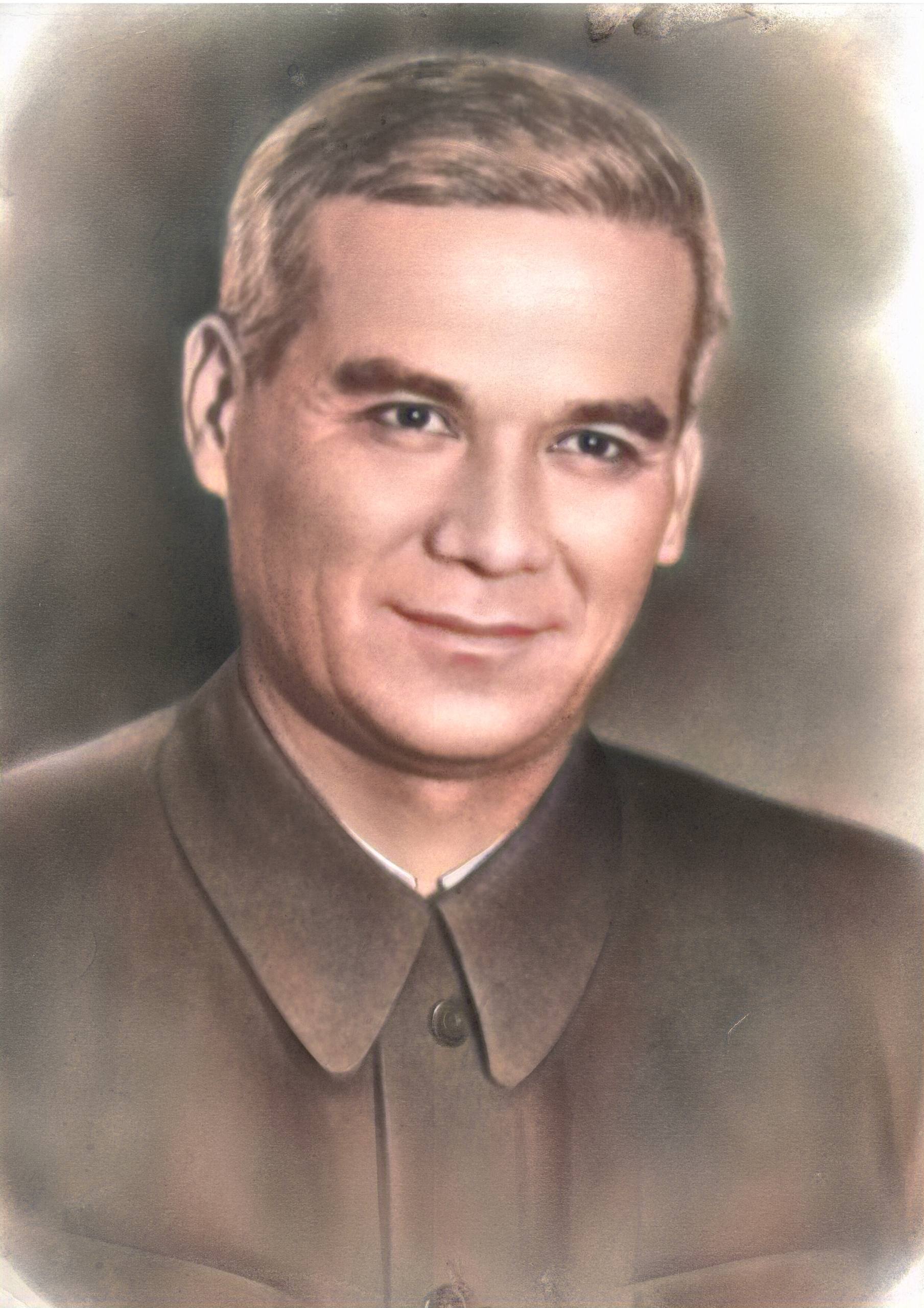
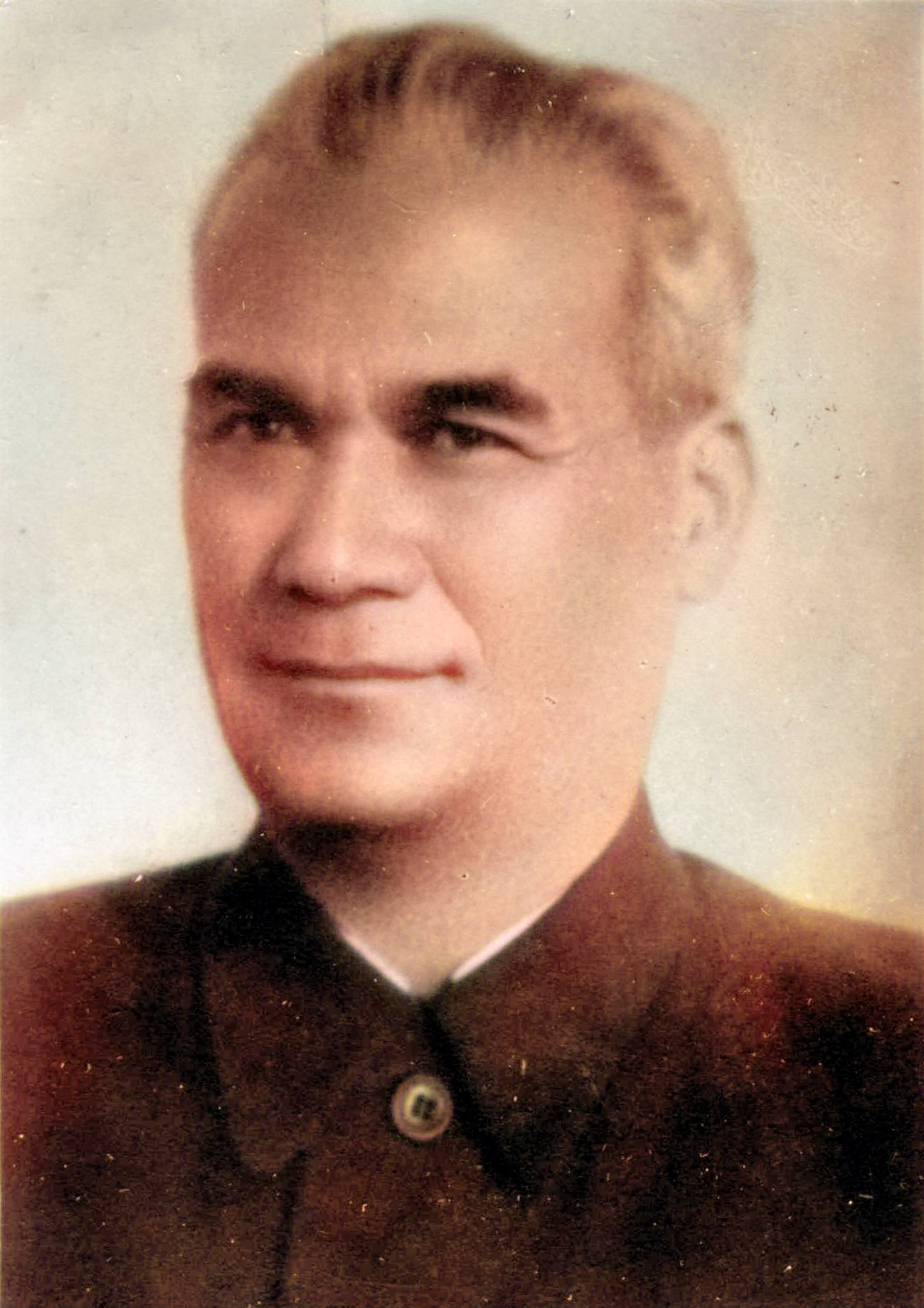
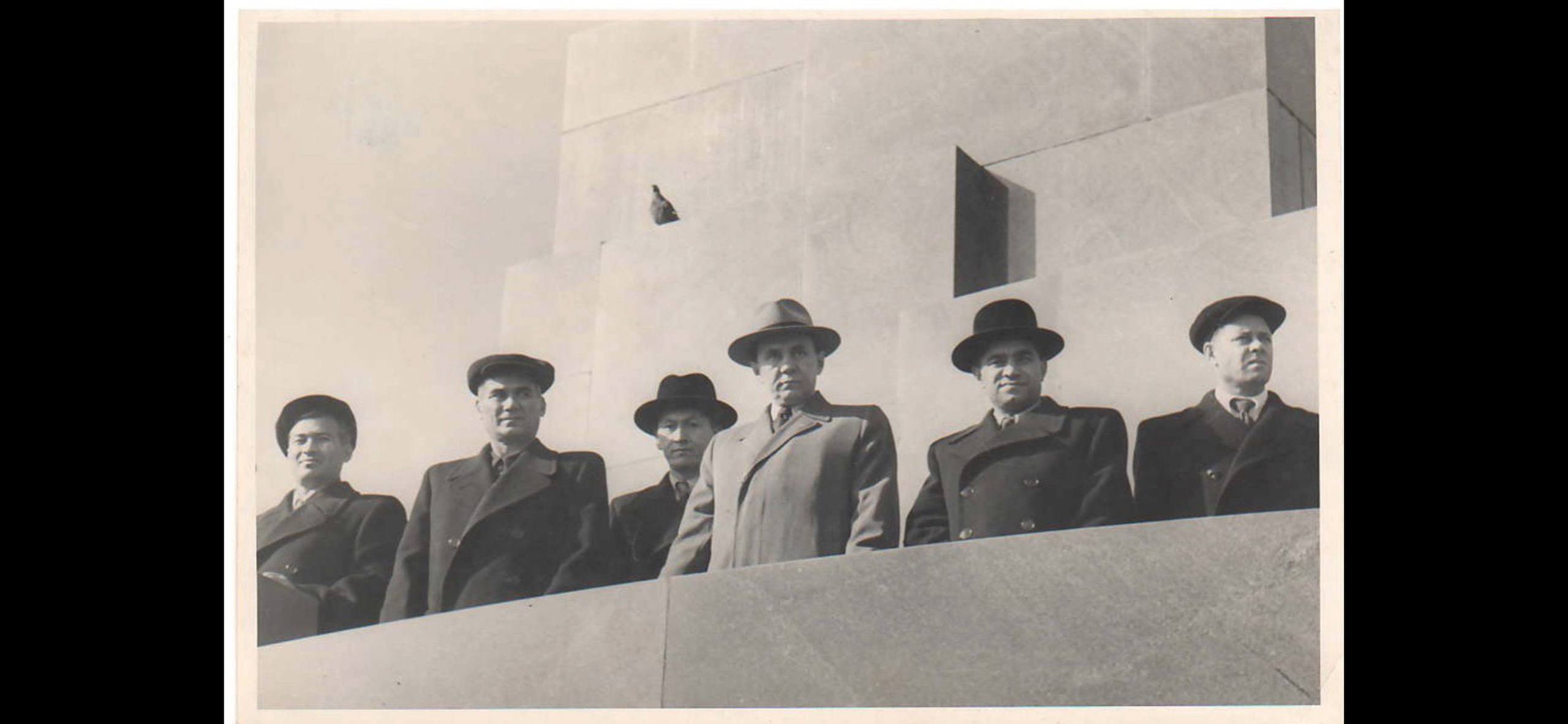
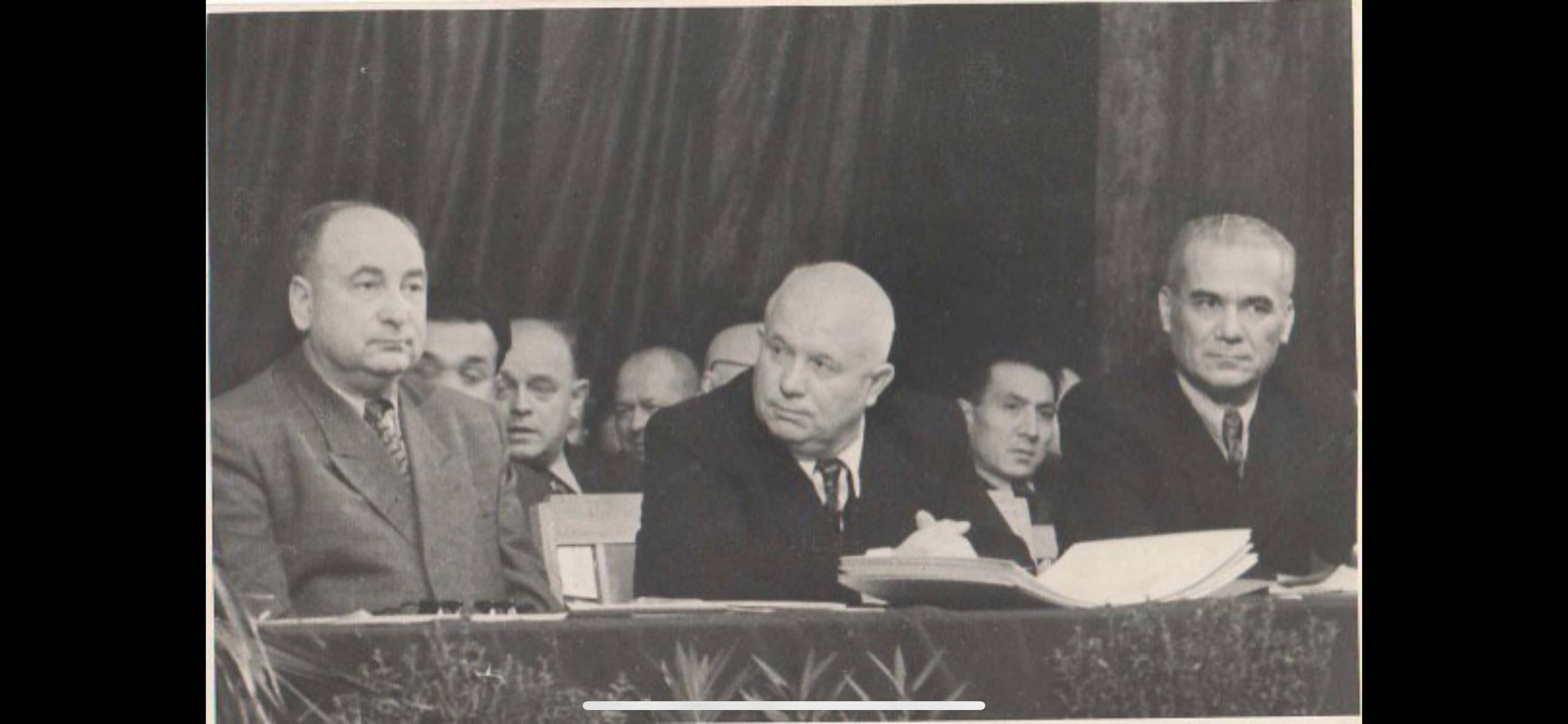
Rare photographs from the family archive and published memoirs, documenting key moments in Amin Niyazov's life and the leaders he worked alongside.
Family Legacy
Aminjan Niyazov's wife, Salimakhon Niyazova, was described by the family as "the keeper of the family hearth, his faithful helper and reliable support" through decades of war, political upheaval, and tireless public service.
Together they raised four children, each of whom pursued professional careers in service of their republic:
The Niyazov family's tradition of service — to their republic, to their people, and to the public good — has continued through the generations, carried forward by his children and grandchildren.
Sources
This memorial draws on family records, Soviet-era reference works, contemporary press coverage, and modern scholarly research. Where the family's oral history and the archival record diverge, both are presented with appropriate attribution.
Biographical references
- "Amin Niyazov," Wikipedia (English)
- «Ниязов, Амин Ирматович», Википедия (Russian)
- Great Soviet Encyclopedia, 2nd edition, vol. 30, p. 44
- K.A. Zalessky, Stalin's Empire: Biographical Encyclopedic Dictionary (Moscow: Veche, 2000), p. 337
- Family memorial text (unpublished), shared by the Niyazov family
Cotton politics, dismissal, and the Aral Sea
- Riccardo Mario Cucciolla, The Crisis of Soviet Power in Central Asia: The 'Uzbek Cotton Affair' (1975–1991), PhD dissertation, IMT School for Advanced Studies, Lucca (2017)
- Donald S. Carlisle, "Power and Politics in Soviet Uzbekistan: From Stalin to Gorbachev," in Soviet Central Asia: The Failed Transformation, ed. William Fierman (Boulder: Westview Press, 1991)
- Mark Synnott, "Sins of the Aral Sea," National Geographic, June 2015
- «Венецианская биеннале искусств: каким будет павильон Узбекистана», Gazeta.uz, 9 May 2026
- USSR Council of Ministers and CC CPSU, Decree N° 1059, "On the irrigation of virgin lands of the Hungry Steppe in the Uzbek SSR and the Kazakh SSR for increasing cotton production," 6 August 1956
- Igor S. Zonn et al., The Aral Sea Encyclopedia (Berlin: Springer, 2009)
Wartime evacuation and Jewish refuge in Uzbekistan
- "Israeli embassy opens monument to Uzbeks who assisted Holocaust refugees," The Jerusalem Post, 29 May 2022
- "New monument in Tashkent spotlights Uzbek role in saving Jews during Holocaust," JNS, May 2022
- "Uzbekistan Soviet Republic Becomes New Home for Hundreds of Thousands of Evacuated Jews," JTA Daily News Bulletin, 19 February 1942
- JewishGen / USHMM, "Registration Cards of Jewish Refugees in Tashkent, Uzbekistan during WWII" (Central Asia Research Project, 2004–2006)
- Rebecca Manley, "To the 'City of Bread'? Holocaust Evacuation to Tashkent," S:I.M.O.N., Vienna Wiesenthal Institute
Contemporary press coverage
- "Goodby, Mr. Niyatov" (editorial), reprinted from the Washington Evening Star in The Troy Record (Troy, NY), 5 January 1956, p. 10
- Brief dispatch on Niyazov's dismissal, The New York Times, late December 1955 (cited in the editorial above)